HAPPY NEW YEAR 2015! - KEEP TRAVELLING TO FEEL ALIVE ;)
Showing posts with label love. Show all posts

Sunday, 28 September 2014

Kayseri in our bags (Turkey I)

Hi everyone! After a long time, Isak and I enjoyed some time together again in one of the most beautiful countries I’ve ever been, TURKEY! We had dreamt for two years about this trip and finally we made it. It was a short trip for this country, only 13 days, that’s why we didn’t have time to rest or even to sleep. Everyday we woke up early, went out, walked around all the cities and spent some hours on the plane or in the bus (once we had to travel for13 hours! I don’t recommend it). But we didn’t care about this bustle because we had a lot of awesome and lovely moments together that we will always keep in our memories.

During this trip we visited 5 cities, 1731 km: Kayseri, Cappadocia, Fethiye, Antalya and Istanbul.


In this post we will write about Kayseri, a city in the centre of Anatolia next to a well-known area, Cappadocia. Due to its airport and the short distance between the city and Cappadocia (about 1 hour by car), many tourists decide to visit Kayseri. The actual reason why we decided to stay in Kayseri is because Isak (My Panda :*) and his family live there, so we spent 2 days discovering the most important places and delicious Turkish food.


First of all, the main attraction in Kayseri is its gorgeous and huge Erciye Mountains. If you like skiing and want to spend your holidays here, these mountains are the best option because they have the longest sky slope in the world. Moreover, you should know that it is a half active volcano. The heart of the mountain is still filled up with lava.


The Grand Bazaar is another important stop that you should make in your tour. This bazaar is the biggest one in the centre of Turkey and it was built in the 13th century. It has around 600 shops where you can find real Turkish objects related to the tradition of its culture. We were in two different bazaars in Istanbul too (we will write a new post for this trip) but I personally prefer Kayseri Grand Bazaar because there are not too many tourists and you really can feel the traditional environment of Anatolia and see how Turkish people are in their daily life.


Our next stop was Republic Square where there is a huge Atatürk Statute in the middle. In this trip I realised that Atatürk is one of the most important people in Turkey, even after his death. He was the founder of the Turkish Republic and the founder of the new Turkey in 1923.


 Hunat Camii and Madrasah is a very interesting place to visit in Kayseri. Madrasah is a Muslim school, college or university that is often part of a mosque. Nowadays, this place is used for people to drink a tea in a quiet environment or to visit some of the antique Turkish customs in some of the several rooms there are here.


                                        Entrance of the building                          Isak, the best tour guide ;)

In one of the rooms there was a man who was painting flowers and other different paintings on posters with water and a kind of oil. This is a famous Turkish art called “Ebru”.

:’( I forgot mine

There were some women who were weaving pretty carpets which you can buy for a high price. In Turkey, weaving a carpet is another kind of art. All Turkish citizens have some of them in their houses and they have an important meaning in their home.


Nobody can deny that Turkish food is very tasty and extremely delicious. Don’t worry, we will write a post for popular meals and desserts in Turkey. For now, I’m leaving you a sneak peek, Just fall in love with all these edible presents that you can find in every corner of Kayseri:

Famous baklava

Kayseri pastirmasi

Halka tatlisi

Dried fruits and nuts
Turkish delights (Irene's mum favourites)

Famous manti from Kayseri


Kayseri used to be the central trade centre of Anatolia (today’s Turkey) but even now it is one of the trade centres of the country. Kayseri pushed the button for tourism and making huge investments for tourism. It’s a city full of historical heritages and culture.


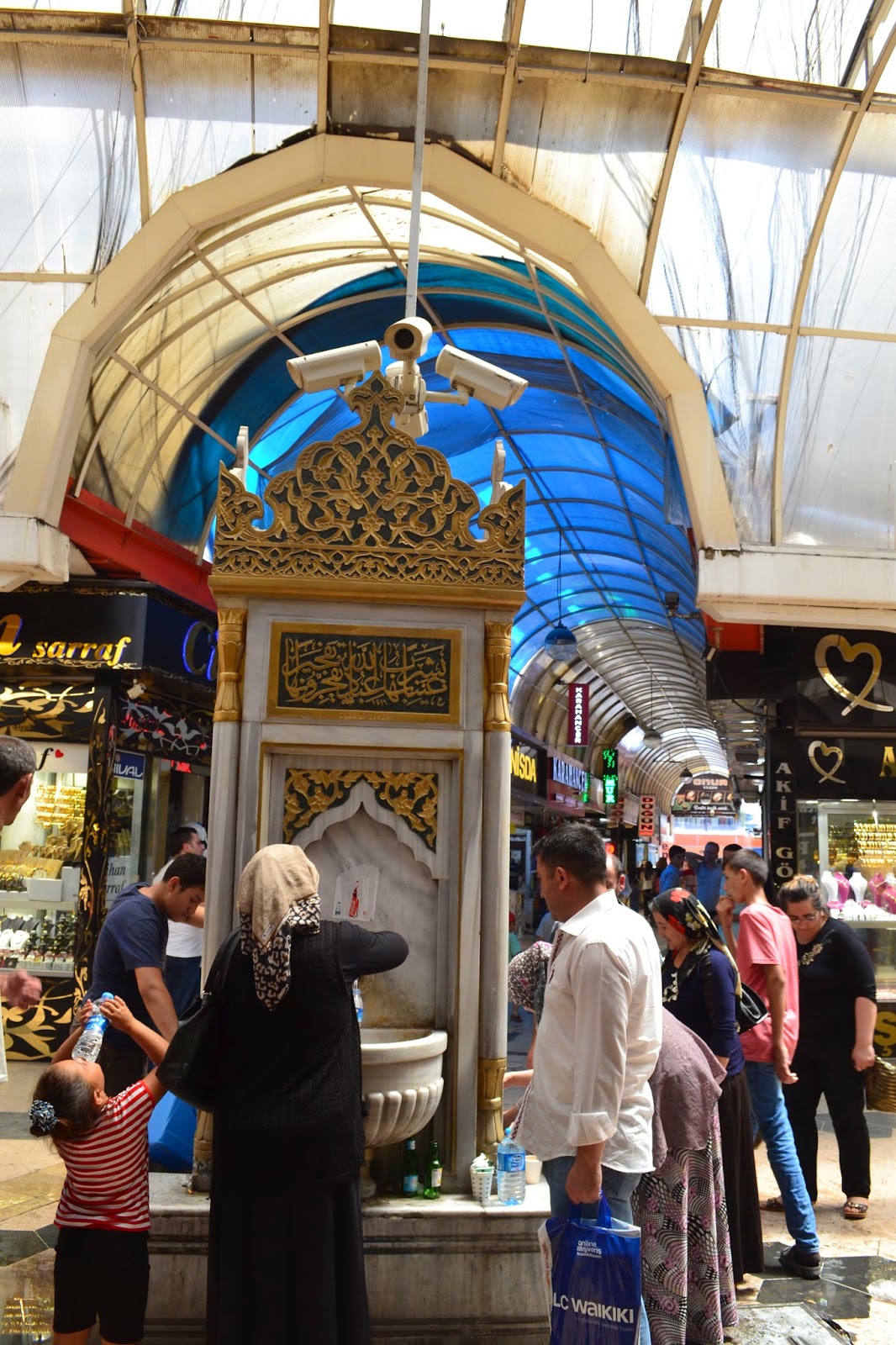
It is common to find fountains in Turkey around parks, squares, mosques or bazaars with drinkable water. It’s an Islamic tradition (more than 92% of the population in Turkey are Muslims) and a cultural component too. Cleaning is the basis of Islam.


Most important and famous Architect of the world was Mimar Sinan the Arch, architect of Ottoman Empire in the 16th century. He designed and built hospitals, food houses, libraries, schools, Madrasahs and mosques all around the world.

Mimar Sinan The Arch Architect of Ottoman Empire in 16th Century 


In the next picture we have the famous postcard of Kayseri. On the left side you can see Kayseri castle. On the right side Merkez Mosque.


Please leave an e-mail or comment if you have any questions
Regards


Irene Jimenez & Isak Uzun

Saturday, 23 November 2013

Door Hunt @ Cordoba


Hey there folks, the doors and the doorknockers are really interesting at cordoba, they had my attention soo much and we wanted to share it with you all. Actually we can say thet in old times these doorknockers used to symbol the characteristics of the house owner's family, but today these are just being used as a decorative object we think. Enjoy folks :) 


Please leave an e-mail or comment if you have any questions

Regards

Irene Jimenez & Isak Uzun


Tuesday, 22 October 2013

Córdoba in our bag

The Cathedral of Cordoba
Córdoba once the capital city of the Moors, the capital of the Muslim Spain. Old historians describe the Córdoba as the culture and science capital of the world. 


The Cathedral of Cordoba
First of all a suggestion to all beware of the killing hot weather in Córdoba, especially if you are not use to hot weather. Córdoba is extremely hot but nice and welcoming city. You can see the Muslim architecture and the amazing heritage of the Moors. 


Main door of  the Cathedral of Cordoba 

Internal view of Cathedral
Actually it’s the amazing structure, once one of the biggest Mosques in the Europe that build by the Moors and is the main attraction in the city.


Christian effects in the old Mosque

Christian effects in the old Mosque

Christian effects in the old Mosque


The construction started in the year of 785. In 1236, after the Christian invasion the mosque was turned in to a cathedral by the Christians.


A clue for u till 10:00 in the morning its free to enter inside the cathedral after 10:00 its more than 10 euros.


Galeria De La Inquisicion ( Inquisition Museum) 
In Córdoba between the narrow streets you can fınd the hidden Inquisition Museum. The entrance is 5 Euros (2012). If you have a chance definitely visit the museum.


You can smell the history, culture, religion and the wonderful heritages in the city everywhere. One thing we didn’t like in the city, there are many beggars and gypsies begging for money and such things and they don’t let you go easily.

Where the Equestrian show happens :) 

View from Alcázar de los reyes cristianos

Alcázar de los reyes cristianos

This is an old fortress and the Catholic Monarchs of Spain used it as a residence for eight years. You can visit the patios, the towers and a beautiful garden, full of flowers and trees. Also, there is a statue that means the meeting between the Catholic Monarchs and Cristobal Colón. 


Gardens of Alcázar de los reyes cristianos

Catholic monarchs and Cristobal Colón

Ornamental pools of Alcázar de los reyes cristianos

Ibn Rüsd - Averros

Averros, commonly known as Ibn Rushd or by his Latinized name Averroës was a Spanish Andalusian Muslim polymath, a master of Aristotelian philosophy, Islamic philosophy, Islamic theology, Maliki law and jurisprudence, logic, psychology, politics and Arabic music theory, and the sciencesof medicine, astronomy, geography, mathematics, physics and celestial mechanics. Averroes was born in Córdoba, Al Andalus, present-day Spain, and died in Marrakesh, present-day Morocco. He was interred in his family tomb at Córdoba. The 13th-century philosophical movement based on Averroes' work is called Averroism. (http://en.wikipedia.org/wiki/Averroes)


Colorful seramics


Left side of the The Cathedral of Cordoba there is a seramic galeria, its bloody expensive but there are cheap and nice things as well. Highly recommended.


Calleja de las Flores


In Córdoba nearly all the courtyards are decorated with colorful flowers, if you have the chance to visit Córdoba the first week of May, don’t forget that they celebrate an important competition to choose the best courtyard in the city.


Bridge Gate

Guadalquivir River 


Córdoba was an important city that Romans, Muslims and Christians fought to have the control of it and also because of its strategic situation in Andalucía. Córdoba is divided into two parts by Guadalquivir River, one of the most important rivers in Spain. You can cross it side by side through the Roman Bridge and take pictures of the city at night. 


Famous Roman Bridge in Cordoba

La casa andalusí

This house was a great surprise for us. We were walking between the narrow streets when we saw a house, but not a normal house. There was a sign and it said “Casa andalusí” what it means Andalusian style house so we didn’t doubt and entered. We suggest you to visit this little and cute place because it is full of objects related to Islamic culture. 

La casa andalusí


Whirling Derwish 


Since the first the entrance, Muslim music move us to a magic environment where in every corner you will find new objects and documents (thanks to Isak I could understand the meaning of them) about the Islamic culture.


We recommend you visit it because we are sure that you will discover a new world connected with a Muslim part of Andalucia.


Please leave an e-mail or comment if you have any questions

Regards

Irene Jimenez & Isak Uzun